Giorgio de Chirico
1888 - 1978
Lives in Paris (France), lives in Greece.
Giorgio de Chirico was born in Greece into the family of an Italian railroad engineer and later studied in Athens, Florence and Munich, where he was much influenced by Nietzsche's philosophy and Arnold Böcklin's Symbolist art. In 1910, de Chirico moved to Paris where he made contact with Picasso and befriended Guillaume Apollinaire. In Paris he began to produce highly troubling dreamlike pictures of deserted cities, eg. The Great Tower, The Soothsayer's Recompense, Mystery and Melancholy of a Street, etc.; pictures with fantastic combinations of images that carried a charge of mystery, eg. Love Song, Portrait prémonitoire de Guillaume Apollinaire, The Uncertainty of the Poet, et al. The same haunting shapes tend to appear again and again in poetic combinations.
In 1917 in the Ferrara military hospital, de Chirico met a compatriot, also a painter, Carlo Carrà (1881-1966), and together they founded Metaphysical painting. De Chirico's Metaphysical paintings were hugely influential on Surrealist artists, who recognized in them the eloquent expression of the unconscious and nonsensical to which they themselves aspired. In 1918 de Chirico and Carrà contributed to the periodical Valori Plastici which gave a literary aspect to Metaphysical painting. By the 1930s de Chirico had moved to a more conventional form of expression. His great interest in archeology and history took the form of Neo-Baroque paintings full of horses, still-lifes, and portraits. The Surrealists, in particular, condemned his later work.

M HKA Art Works
View all-
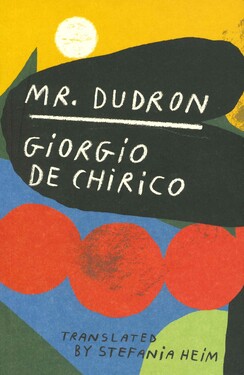
Mr. Dudron
Giorgio de Chirico, Mr. Dudron, 2024. Artist Novel, 18,5 x 12 cm, 120 p., language: english, publisher: a public space books, new york, isbn: 9781736370988 .
-
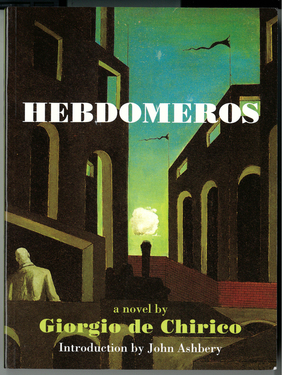
Hebdomeros (with Monsieur...
Giorgio de Chirico, Hebdomeros (with Monsieur Dudron's Adventure and other Metaphysical Writings), 1992. Book, ink, paper, 20.2 x 15.1 cm, 258 p, language: English, publisher: Exact Change, Cambridge, MA, ISBN: 978-1-878972-06-4.
Items
View all-
Hebdomeros (with Monsieur...
Giorgio de Chirico, Hebdomeros (with Monsieur Dudron's Adventure and other Metaphysical Writings), 1992. Book, ink, paper, 20.2 x 15.1 cm, 258 p, language: English, publisher: Exact Change, Cambridge, MA, ISBN: 978-1-878972-06-4.
-
Mr. Dudron
Giorgio de Chirico, Mr. Dudron, 2024. Artist Novel, 18,5 x 12 cm, 120 p., language: english, publisher: a public space books, new york, isbn: 9781736370988 .
Events
View all-
Book Lovers 4.0 (Pop-up B...
28 January 2014 - 02 February 2014.
The Book Lovers presents the first (pop-up) bookstore specialized in artist novels. The bookstore will be hosted by De Appel and run by Buchh -

The Preparation of the No...
18 July 2014 - 05 September 2014.
The Preparation of the Novel is the title of a new instalment in The Book Lovers project, which makes direct reference to Roland Barthes’ tra
Ensembles
View all