William Morris
+ 1896
Born in United Kingdom.
The son of a wealthy businessman, William Morris enjoyed a comfortable childhood before going to Marlborough and Exeter College, Oxford. His admiration for the Pre-Raphaelites led him to be introduced to Dante Gabriel Rossetti whose influence can be seen on Morris's only surviving painting La Belle Iseult. In the 1860s Morris decided that his creative future lay in the field of the decorative arts. The 'Firm' (later renamed Morris & Co) was particularly well-known for its stained glass, examples of which can be seen in churches throughout Britain. Morris produced some 150 designs which are often characterized by their delightful foliage patterns. Among his many other works were Icelandic and classical translations, Sigurd the Volsung, The Pilgrims of Hope, and a series of prose romances which included A Dream of John Ball, News from Nowhere, and The Well at the World's End. Morris entered national politics in 1876 as treasurer of the Eastern Question Association. He soon became disillusioned with the Liberals and in 1883 joined the socialist Democratic Federation. After disagreements with the Federation's leader, H. M. Hyndman, he formed the Socialist League, and later the Hammersmith Socialist Society. During the 1880s he was probably the most active propagandist for the socialist cause, giving hundreds of lectures and speeches throughout the country. In 1890 Morris founded the Kelmscott Press. In all, sixty-six volumes were printed by the Kelmscott Press. Morris died at Kelmscott House on 3 October 1896.

M HKA Art Works
View all-
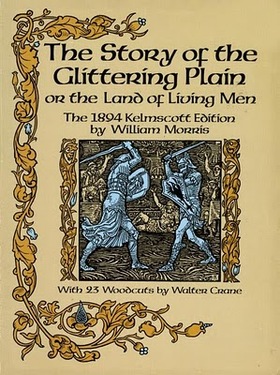
The Story of the Glitteri...
William Morris, The Story of the Glittering Plain, 1891. Book, ink, paper, language: English, publisher: Kelmscott Press, ISBN: N/A.
-

Child Christopher and Gol...
William Morris, Child Christopher and Goldilind the Fair, 1895. Book, ink, paper, 2 volumes: 256 p, 239 p, language: English, publisher: Kelmscott Press, ISBN: N/A.
-

The Sundering Flood
William Morris, The Sundering Flood, 1897. Book, ink, paper, 508 p, language: English, publisher: Kelmscott Press.
-

The Well at World's End (...
William Morris, The Well at World's End (Volume 1), 2000. Book, ink, paper, 20.5 x 12.5 cm, 320 p, language: English, publisher: Berkeley Heights, NJ: Wildside Press, ISBN: 1-58715-088-3 .
Items
View all-
The Well at World's End (...
William Morris, The Well at World's End (Volume 1), 2000. Book, ink, paper, 20.5 x 12.5 cm, 320 p, language: English, publisher: Berkeley Heights, NJ: Wildside Press, ISBN: 1-58715-088-3 .
-

The Well at World's End (...
William Morris, The Well at World's End (Volume 2), 2000. Book, ink, paper, 20.3 x 12.7 cm, 242 p, language: English, publisher: Berkeley Heights, NJ: Wildside Press, ISBN 1-58715-089-1.
-

A Dream of John Ball and ...
William Morris, A Dream of John Ball and A King's Lesson, 2007. Book, ink, paper, 20.8 x 13.4 cm, 143 p, language: English, publisher: Boston, Massachusetts: Adamant Media Corporation, ISBN: 9780543682284.
-

Wood Beyond the World
William Morris, Wood Beyond the World. Book, ink, paper, 20.5 x 13.3 cm, 157 p, language: English, publisher: Hamburg: tredition GmbH, ISBN: 9783842427235.
Events
View all-

WHAT HAPPENS WHEN THE ART...
07 December 2012 - 21 April 2013.
[novels written by artists] The Book Lovers is a systematic attempt to study the phenomenon of artist novels. There are some examples of art -

The Book Lovers – A Proje...
25 January 2013 - 09 March 2013.
Curated by [David Maroto](http://ensembles.mhka.be/actors/david-maroto) and [Joanna Zielińska](http://ensembles.mhka.be/actors/joanna-zielins -

Book Lovers 4.0 (Pop-up B...
28 January 2014 - 02 February 2014.
The Book Lovers presents the first (pop-up) bookstore specialized in artist novels. The bookstore will be hosted by De Appel and run by Buchh -

The Preparation of the No...
18 July 2014 - 05 September 2014.
The Preparation of the Novel is the title of a new instalment in The Book Lovers project, which makes direct reference to Roland Barthes’ tra
Ensembles
View all