Jef Verheyen - Shared Works
Ensemble
In 1957, 25-year-old Verheyen moved to the modern metropolis of Milan, where he met Lucio Fontana (1899-1968), the Argentinian-Italian painter, sculptor and theorist. Verheyen sees Fontana and his Concetto Spaziale as a soulmate to explore the spatial aspect of art. As early as 1946, Fontana advocated a different approach to time and space in Manifesto Blanco. Fontana is a lot older than Verheyen, but the two are on the same wavelength, as is evident from the letters they write to each other.
In Milan, Verheyen also forged ties with the artists Roberto Crippa (1921-1972) and Piero Manzoni (1933-1963). The impact of Manzoni's achrome art on Verheyen's own work is not long in coming. labyrinthine, cosmic painting gives way to pure monochromes, painted with one color, a new kind of essence.
With his exploration of the phenomenon of 'light', Jef Verheyen later also joined the ZERO movement in Italy, Germany, Switzerland, France and the Netherlands. On his painting level, while they work with lamps, reflectors and mirrors. Despite the difference in artistic practice, Verheyen also finds partners in the ZERO movement to collaborate with in multimedia. He emerges as a curator and commits his international network to total concepts in which craftsmanship, science, art and architecture merge. Jef Verheyen places post-war Antwerp on the map, alongside Milan, Paris, Düsseldorf and Amsterdam.
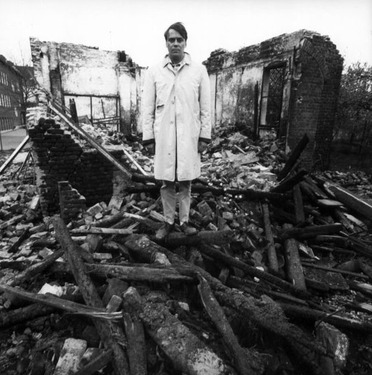
Fontana, Van Anderlecht and Hermann Goepfert (1926-1982) are the ideal partners who support hybrid art forms. Within the group of ZERO artists, it is mainly with Günther Uecker (°1930) that Verheyen builds up a close bond of friendship. Fraternally they organized the open-air exhibition Flemish Landscapes in the countryside in Mullem in 1967. The duo places a large window frame in the landscape to direct the view to the sky, as a tangible window to infinity. It is the complete dematerialization of art, and one of the most conceptual interventions of Verheyen's career. It doesn't end with this performance. The artist also makes small versions with titles such as Le Vide and Le Plein and also integrates the 'limitation of nothingness' into his painting.

Items
View all-
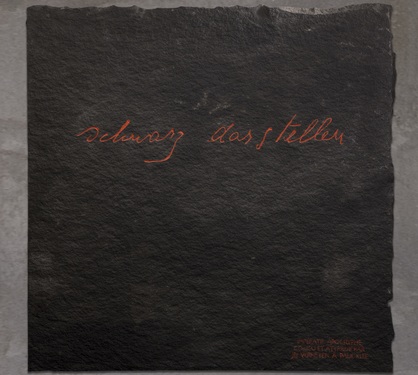
• 0773 • Schwarz Darstell...
Dominique Stroobant, • 0773 • Schwarz Darstellen - Hommage to Jef Verheyen, 2009-2010. Sculpture, black (swedisch) granite, 7 x 92 x 96 cm.
-
Signed photo of Günther U...
Jef Verheyen, Günther Uecker, Lothar Wolleh , Signed photo of Günther Uecker with inscription 'Jef, in deine reine Vision des Lichts möchte ich mit meinen Nageln eindringen. Uecker 67', 1967. Photography, ink on photograph.
-
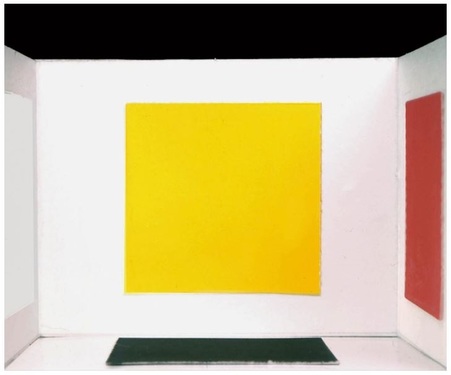
• 0713 • La Grande Couleur
Herbert Distel, Kunsthaus Zürich, Jef Verheyen, • 0713 • La Grande Couleur, 1965-1975. Installation, environment with 5 paintings on paper mountings, on 2 additional cardboard mountings (on all walls and floors), drawer: 5.5 x 32.5 x 30.5 cm, casket: 43 x 57 x 48 mm.
-
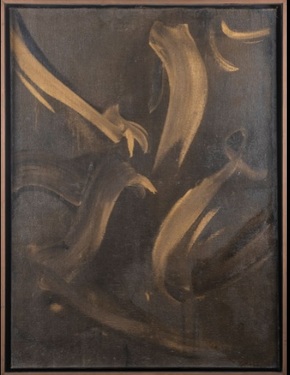
• 0700 • L'un et l'autre ...
Galerie Cotthem, Englebert Van Anderlecht, Jef Verheyen, • 0700 • L'un et l'autre - ni l'un ni l'autre (12), 1960. Painting, oil paint on burlap, 130 x 97 cm (framed after artist's death).
Actors
View all-
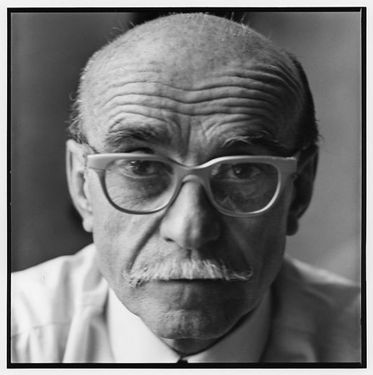
Lucio Fontana
The Argentine-Italian visual artist Lucio Fontana (1899-1968) has broadened and deepened the avant-garde of the mid-twentieth century with ne
-

Jef Verheyen
Jef Verheyen consistently marched to the beat of his own drum within the history of Flemish, Belgian and international abstract art from 1954
-

Englebert Van Anderlecht
Jef Verheyen and Englebert Van Anderlecht became good friends after Verheyen introduced Van Anderlecht to Enzo Pagani as well as to Hans Liec
-
Günther Uecker
On his participation-sheet for Vision in Motion, Uecker calls his works ‘Objecte’. The monochrome white and yellow canvases on panel, and a w