MONOCULTURE – TENTOONSTELLINGSGESCHIEDENISSEN
Ensemble
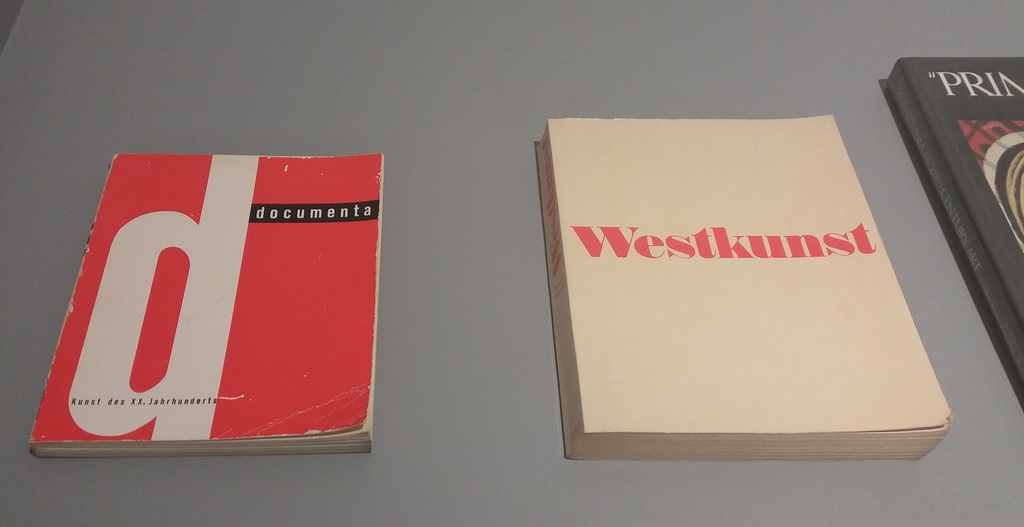
The first documenta was held between 15 July and 18 September 1955 in Kassel, Germany. Although close to the Latin word – documentum meaning: a lesson or warning, the title of the exhibition is an invented word that was supposed to embody the intention to be a documentation of modern art. This catalogue of an extensive exhibition of modern art, co-curated by Laszlo Glozer and Kasper König in Kölnermessehallen, Cologne (30 May – 16 August 1981). Intentionally provocative, the title Westkunst is a pun on the word ‘Weltkunst’ (World Art). It was intended to refer to the hegemonic Western ideology as well as the existing political and ideological division of Europe into West and East. The exhibition "Primitivism" in 20th Century Art: Affinity of the Tribal and the Modern, was led by William Rubin and Kirk Varnedoe at MoMA in 1984. Having juxtaposed tribal and Modernist artworks according to their formal resemblances, it was extensively criticised for its valorisation of Western art practice at the expense of the so-called “primitive” one. Often regarded as a direct response to MoMA’s controversial exhibition, Magiciens de la Terre was organised by French curator Jean-Hubert Martin five years later. Though praised by some for its attempt to depart from Eurocentric perspectives, the exhibition was also condemned by others for its formalist approach, de-contextualisation and de-politicisation of artworks, particularly of those from outside of the West. The Other Story, curated by the artist and theorist Rasheed Araeen at the Hayward Gallery, was the first major survey of the works of artists of Asian, African and Caribbean origin in Britain made in the post-war decades. Having taken place during the era of Margret Thatcher’s Conservative government, the exhibition is considered a significant attempt at the ‘de-imperialisation’ of the ‘master narrative‘ of modern art history.