 Back
Exhibition (Group): Old Guard? Avant-garde!
06 June 2026 - 13 September 2026
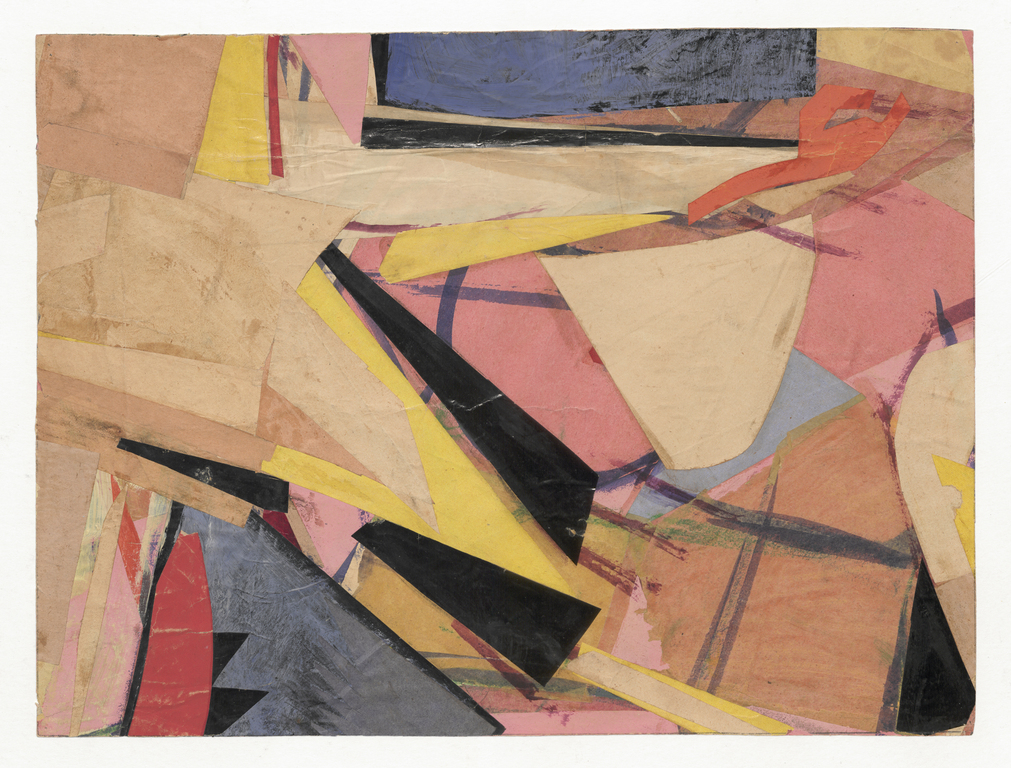
Paul Joostens, Compositie, datum onbekend, collage, privé-collectie, Schilde
Media


M HKA, Antwerpen
At the end of Roaring Twenties, the historical avant-garde begins to fade. Some modernists return to classical painting, whilst others abandon their artistic pursuits altogether. Yet, old habits die hard. Old Guard? Avant-garde! shows how, inspired by a new generation of experimental artists, the pioneers of the 1920s radicalise once more in the 1950s.
The original trailblazers’ new experiments take on diverse forms. Jozef Peeters, for instance, picks up abstract painting like no time has passed and joins the artistic plans of the young artists from Group 58, Floris Jespers periodically dabbles in new techniques and concepts, whilst Paul Joostens remains his inimitable yet ever-authentic self. In the meantime E.L.T. Mesens actively seeks out the company of a new generation of avant-gardists. Inspired by the latest art from Italy, he develops a hybrid of surrealism and futurism.
The encounter between older and younger artists in the late 1950s is a pivotal moment in art history. It marks the beginning of a second avant-garde, at the same time it kicks off the historiography of the first avant-garde.
From the late 1950s onwards, the narrative that shapes the history of Flemish Modernism to the present day begins to take shape. The seeds of this narrative were already sown in the introductory text written in 1954 by the artist and art journalist Maurits Bilcke for the exhibition The First Abstract Artists in Belgium at the Saint Laurent gallery in Brussels:
Abstract art remained in the shadows. The interest of both critics and art lovers was, in fact, systematically focused on expressionism and later on surrealism.
For Bilcke, abstract art is the logical culmination of Modernism. He positions it diametrically opposed to expressionism and surrealism.
In doing so, Bilcke inadvertently exacerbates the rivalry between the school of Paul van Ostaijen, who introduced the Modernist idea to Flanders during the First World War but never sought out pure abstraction, and the abstract constructivists Jozef Peeters and Michel Seuphor. Thirty years on, Seuphor in particular sees this as an opportunity to enhance his own role in the narrative and to downplay that of Van Ostaijen.
Through his many appearances on radio and TV, Seuphor creates an influential school of thought, though occasionally he encounters an eye witness from the early days. On the TV show Ten Huize Van (1960) Floris Jespers describes the avant-garde as a quest for a synthesis of the modern '-isms.
He characterises his own oeuvre as a 'soup', prepared with the finest ingredients from cubism, expressionism and surrealism. And the original recipe for this soup? He had once received it from
Paul van Ostaijen.
The exhibition is the first of three archive presentations focusing on the post-war impact of Paul van Ostaijen's art theory, in collaboration with Dynamiek!, a project of the Paul van Ostaijen Society.
Curated by: Dennis Van Mol, Matthijs De Ridder, Jan De Vree
The M HKA presents visual arts archives in rotating presentations. These are not only crucial for preserving and making legacies accessible, but also create opportunities for new research.
-

Paul van Ostaijen as a sculptor in the catalogue of the Tweede Kongres van Moderne Kunst, 1922
Other
-

Mr. Penknife, 1923
Edouard Léon Théodore (E.L.T.) Mesens
Other, coloured pencil on paper, 21.5 × 17.5 cm
-

Salopes, 1924
Paul Joostens
Print
-

L'art brut préféré aux arts culturels, 1949
Jean Dubuffet
Book
-

Textuel, 1951
Michel Seuphor
Other
-

Poster by De Nevelvlek for a lecture on Paul van Ostaijen by Staf Rummens, 1953
Poster
-

Zonder titel, 1953
Rene Guiette
Drawing
-

Catalogue of Les premiers abstraits Belges at Galerie Saint Laurent, Brussels, 1954
Book
-

De Vier Hoofdpunten van het surrealisme, 1956
Edouard Léon Théodore (E.L.T.) Mesens
Print
-

Untitled (after a schematic drawing from 1924), 1958
Jozef Peeters
Painting, oil on canvas, 60 x 47 cm
-

Catalogue of the G 58 group exhibition De eerste abstrakten in België, 1959
Other
-

Cover design by Guy Vandenbranden for Herman Uyttersprot, Paul van Ostaijen en zijn proza, 1959
Poster
-

L'oiseleur, 1959
Michel Seuphor
Collage
-

Untitled (for Enrico Baj), 1959
Edouard Léon Théodore (E.L.T.) Mesens
Collage
-

Manuscript of a posthumous letter from Jef Verheyen to Jozef Peeters, 1960
Jef Verheyen
Letter
-

Catalogue of the G58 retrospec tive of Jozef Peeters, 1960
Book
-

Zonder titel, 1960
Paul Joostens
Other
-

Zonder titel, 1961
Edouard Léon Théodore (E.L.T.) Mesens
Other
-

Untitled, 1962
Henri-Floris Jespers
Other
-

Zonder titel, 1965
Henri-Floris Jespers
Drawing
-

Zonder titel, 1966
Rene Guiette
Drawing
-

La pêche du poisson lumiere, 1975
Michel Seuphor
Drawing
-

Dreigende Vormen, 2026
Bruno Kristo, Paul Van Ostaijen
Sculpture
-

Salopes
Paul Joostens
Book
-

Zonder titel (liggend figuur in landschap)
Henri-Floris Jespers
Other
-

Zonder titel
Henri-Floris Jespers
Painting
-

Zonder titel (collage)
Paul Joostens
Collage
-

Zonder titel
Edouard Léon Théodore (E.L.T.) Mesens
Drawing
-

Untitled
Henri-Floris Jespers
Sculpture