← Items Overview
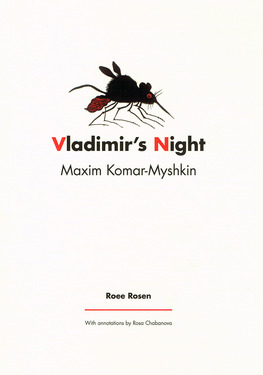
Item: Vladimir's Night
2014
Book, 20 x 30 cm, 174 p, language: English, publisher: Sternberg Press, ISBN: 978-3-95679-059-1.
Materials: ink, paper
Collection: Collection M HKA, Antwerp (Inv. no. B 2026/514).
Literary synopsis
Vladimir's Night is the chimerical final work by Maxim Komar-Myshkin, one of the most elusive and tragic figures in Israeli-Russian art. Part children’s book, part gory political assault and part erotic farce involving elaborately detailed paintings that draw from the most disparate sources, the work is not only Komar-Myshkin's magnum opus, but an instrument of psycho-aesthetic retaliation against Vladimir Putin, whom the artist believed had a personal vendetta against him. Komar-Myshkin committed suicide in 2011, soon after completing the album. In her annotations, Rosa Chabanova explores the book’s many layers, covering such wide-ranging topics as the financial schemes of Russian oligarchs, medieval literature, political assassinations and the massive immigration wave of Russians to Israel. In so doing, Chabanova unravels the haunting story of Komar-Myshkin and arrives at startling conclusions as to what actually transpired during Komar-Myshkin's final years.
Relation of the novel to the artist’s practice
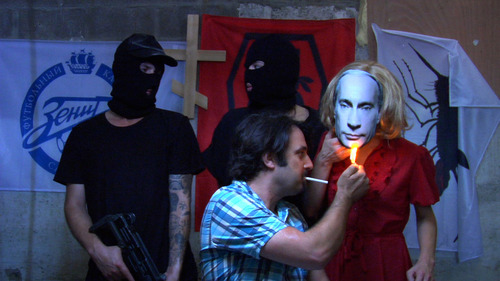
The book is part of a bigger body of works which contains not only Komar-Myshkin's other works, but also those the "Buried Alive Group"—a collective of ex-Soviet artists he formed in Tel Aviv. The group purposefully isolated themselves from the Israeli artistic scene, concerned instead with the political situation in their home country. Their 2004 manifesto states: “We are living Russian corpses, a pack of spiritual zombies. We intently buried ourselves in the Middle-East, but we are still living our Russian past. We are the Buried Alive.” At the time of his suicide in 2011, Komar-Myshkin, the group left behind a series of collectively produced videos
Authorship: Fictional Author.
Creative Strategy: Artwork-Novel Parallel Lives, Fictional Artist Creates Artworks, Novel Art Object.
Genre: Comedy, Erotic/Pornographic, Historical fiction, Historical non-fiction, Speculative Fiction.
Publishing: Art Books Publishing House.
Theme: Animism, Art, Capitalism, Communism, Community, Death, Identity, Money, Objects, Obsession, Paranoia, Parody, Perverse Sexuality, Politics, Post-Soviet Culture, Russian Culture, Sex, Socio-Political Critic, Transgression Identity, Violence.