← Items Overview
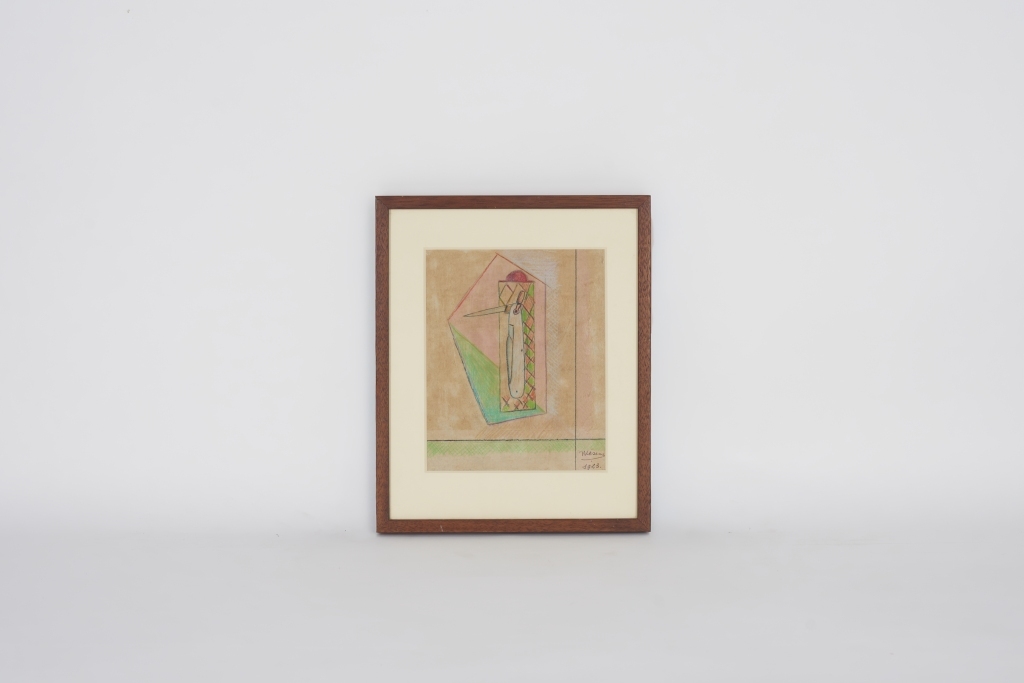
Item: Mr. Penknife
Edouard Léon Théodore (E.L.T.) Mesens
1923
Other, 21.5 × 17.5 cm.
Materials: coloured pencil on paper
Collection: Private Collection / Matthys De Ridder.
Unlike the majority of the protagonists of this archival exhibition, for E.L.T. Mesens the development of the avant-garde did not end in the mid-1920s. For him, abstract art was not an endpoint but a beginning. In 1925, his journey of discovery along the paths of international surrealism had actually yet to begin.
When Paul van Ostaijen has to completely abandon his role as artistic scout due to illness in 1926, Mesens takes over the latter’s position as modernist guide. In the following decade, he emerges as the leading promoter of international surrealism, which he approaches as a ‘militant movement striving for the liberation of the spirit from all moral and logical constraints.’
After moving to London, and starting in the late 1930s, Mesens single-handedly establishes English surrealism from the ground up. In London he reinvents himself as a visual artist. Mesens himself places the beginning of his career as a surrealist in the early 1920s.
He sells or gifts an early work, titled Mr. Penknife, to the British painter Conroy Maddox. In it, much surrealist iconography already seems to be present: the bowler hat, the object brought to life… The work dates from 1923. Or is this the date — a year before André Breton’s Manifeste du surrealisme — he likes to assign to it?
When surrealism threatens to lose its magical power after WWII, the older Mesens — like Jef Verheyen and many other young artists from Groep 58 — orients himself towards Milan and, by extension, Italy. The search by the Italian arte nucleare [nuclear art] artists for meaningful art in the atomic age inspires him. At the same time, he once again draws on the first avant-garde. In his post-war surrealism, Mesens in corporates playful influences from Italian futurism.
Read further here!