Back
Back
Ensemble: Emily Jacir
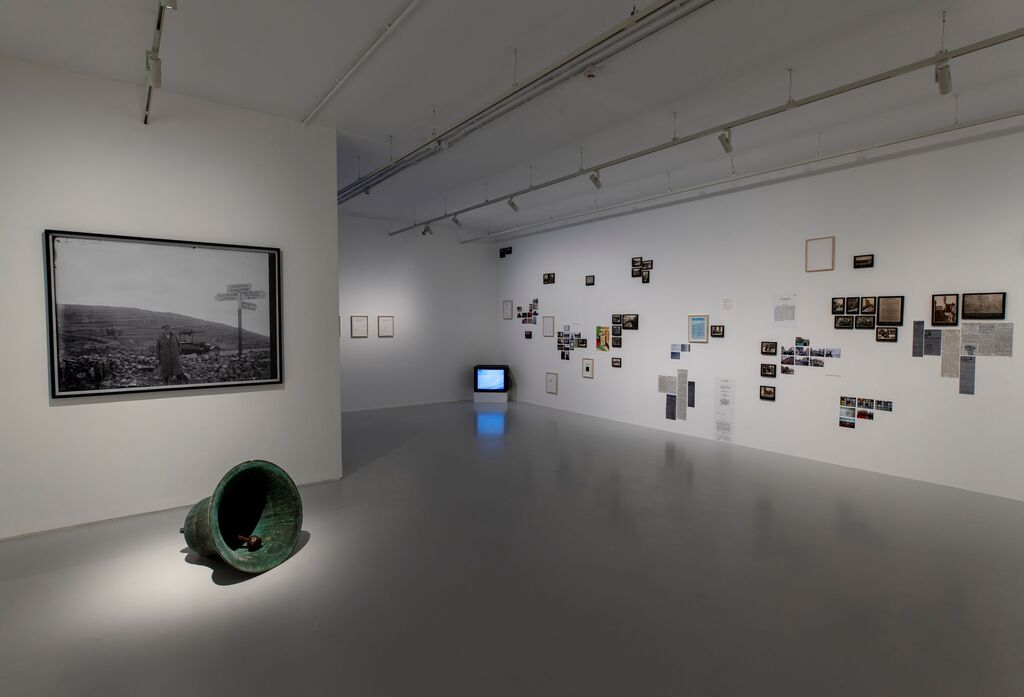
Installation view we refuse_d, Mathaf: Arab Museum of Modern Art, Doha 2025 - 2026
Emily Jacir’s work encompasses film, photography, installation, performance and writing, often focusing on personal and collective movement in public space, examining its implications on the physical and social experience of trans-Mediterranean geographies and temporalities. Through rigorous historical and archival research, Jacir has built a layered and resonant body of work rooted in gathering, community and social affiliations.
Notes for a Cannon explores intertwined histories of British colonial rule in Palestine and Ireland. The installation includes footage Jacir filmed in Akka and in Gaza, drawings, photographs, an 1890 church bell from Armagh, and an Ottoman pocket watch from the same year. The work and an Ottoman pocket watch from the same year. The work takes as a point of departure the Clock Tower once at the Jaffa Gate in Jerusalem and Dublin’s loss of its own time zone, Dublin Mean Time. The Jerusalem tower was destroyed by the British in 1922 to align the city with a biblical vision shaped by colonial imagination. Its removal also erased the coexistence of two perceptions of time, replacing it with a single, standardised measure tied to Greenwich. Notes for a Cannon investigates how multiple temporalities are lived simultaneously. Rather than a linear narrative, Jacir constructs a tactile, layered and associative field where everyday objects become markers of temporal and political violence.
we refuse_d is produced by Mathaf: Arab Museum of Modern Art, Doha, on the occasion of their 15th anniversary, and presented in partnership with M HKA.
Curated by Nadia Radwan and Vasıf Kortun.