Emily Jacir

Ensemble

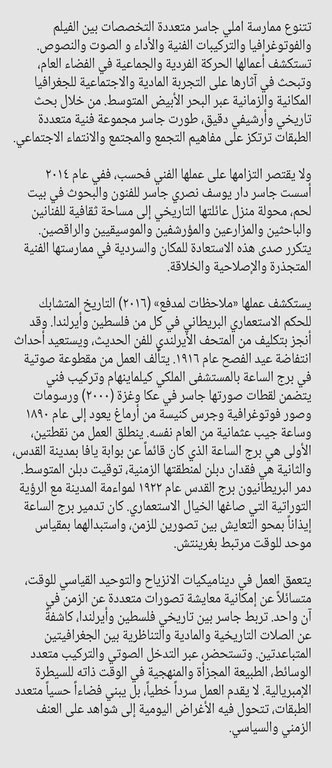
Emily Jacir’s interdisciplinary practice encompasses film, photography, installation, performance, sound, and text. Her work explores both personal and collective movement in public space, examining its implications on the physical and social experience of transmediterranean geographies and temporalities. Through rigorous historical and archival research, Jacir has built a layered and resonant body of work rooted in gathering, community, and social affiliations.
Her commitment extends beyond her artistic practice. In 2014, she founded Dar Yusuf Nasri Jacir for Art and Research in Bethlehem, transforming her historic family home into a cultural space for artists, researchers, farmers, archivists, musicians and dancers. This gesture of reclaiming both space and narrative resonates in her practice: rooted, reparative, and generative.
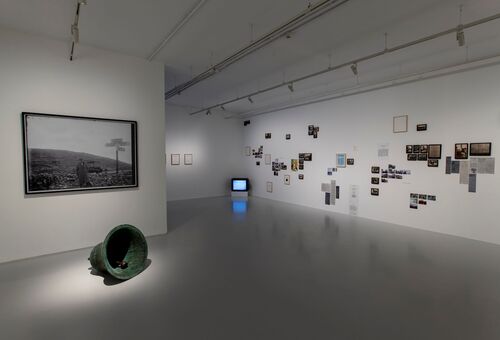
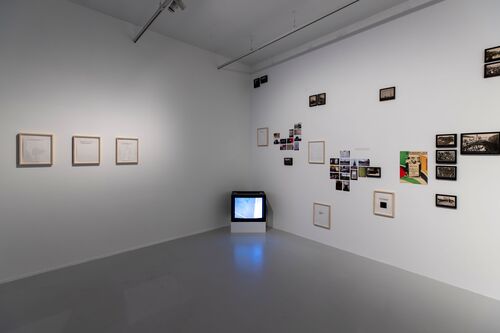
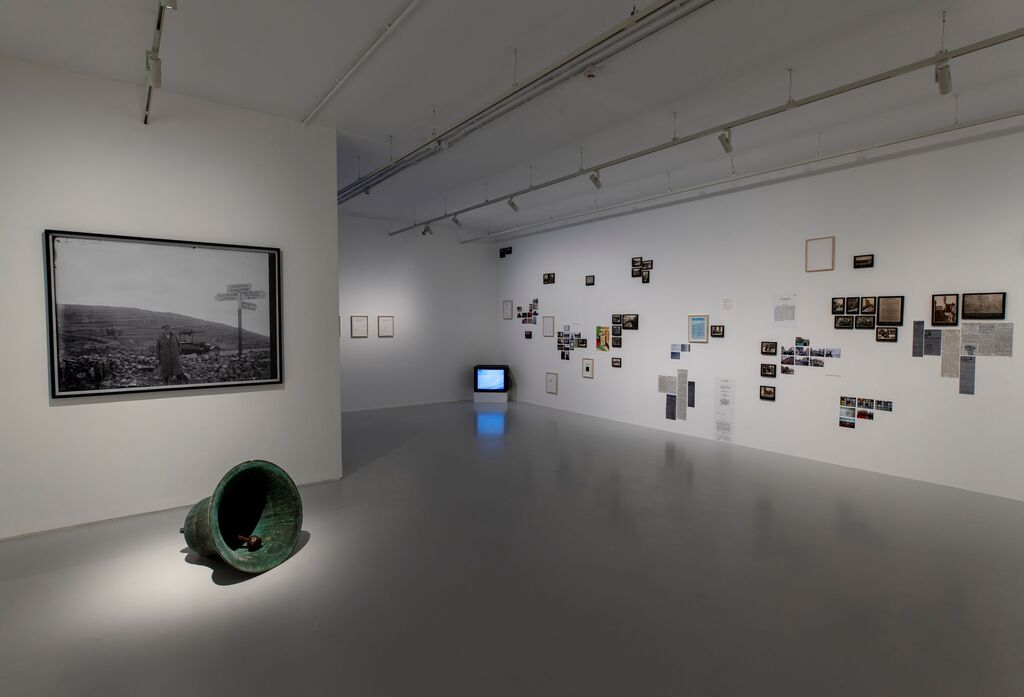
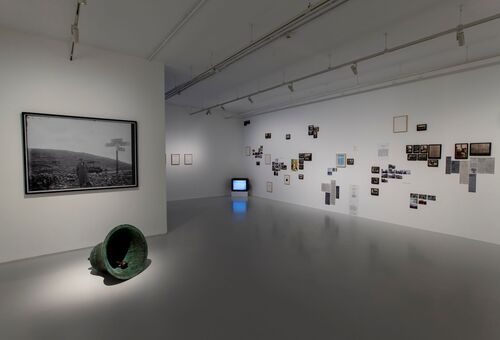
Notes for a Canon (2016) explores intertwined histories of British colonial rule in Palestine and Ireland. Conceived for the Irish Museum of Modern Art, the work is comprised of a site-specific sound work in the Royal Hospital Kilmainham cloister and an installation which includes an 1890 church bell from Acre and in Gaza (2000), drawings, photographs, and a pocket watch inscribed in Arabic and an Ottoman pocket watch from the Jaffa Gate in Jerusalem as a point of departure for the Clock Tower once at the same site. The watch takes an old tower’s lost own time tower, Dublin having its architectural tower destroyed by the British in 1922 to erect a single, standardized beacon shaped by colonial imagination. Its removal was also a direct consequence of two perceptions of time, replacing it with a single, standardized measure tied to perceptions of time.
Delving into the slippages and the standardization of time, Notes for a Canon investigates how multiple temporalities are lived simultaneously, shaped by the histories of Palestine and Ireland, tracing how these temporalities are inscribed by historical, material, and analogical ties. Her staged nature of temporality and work rather than a linear field yet accumulative narrative, instead. Rather than fixed, fragmented, Jacir’s temporality is a fluid and interconnected field where everyday objects become markers of temporal and political violence.


we refuse_d is produced by Mathaf: Arab Museum of Modern Art, Doha, on the occasion of their 15th anniversary, and presented in partnership with M HKA.
Curated by Nadia Radwan and Vasıf Kortun.
About M HKA / Mission Statement

The M HKA is a museum for contemporary art, film and visual culture in its widest sense. It is an open place of encounter for art, artists and the public. The M HKA aspires to play a leading role in Flanders and to extend its international profile by building upon Antwerp's avant-garde tradition. The M HKA bridges the relationship between artistic questions and wider societal issues, between the international and the regional, artists and public, tradition and innovation, reflection and presentation. Central here is the museum's collection with its ongoing acquisitions, as well as related areas of management and research.

About M HKA Ensembles

The M HKA Ensembles represent our first steps towards initiating the public to today's art-related digital landscape. With the help of these new media, our aim is to offer our artworks a better and fuller array of support for their presentation and public understanding.