 Back
Back
Ensemble: Werk van Giambattista Tiepolo [Works by Giambattista Tiepolo]
“In the same way as you relate to history as a human, as a painter you relate in a certain way to the tradition of painting, and in this context the question ‘what can I add to it’ constantly arises.” – Narcisse Tordoir
Giambattista Tiepolo was the favourite artist of the secular and religious rulers of 18th-century Europe. He is referred to as the last of the Venetian painters of the late Baroque. Archbishops and kings commissioned him to paint ceilings and walls in churches and palaces in charming hues. But he also had a darker side. He entrusted his secrets and fantasies to his etchings, of which he did thirty-three, the Capricci (Whims) and Scherzi di Fantasia (Jokes and Fantasies). The aristocracy never made the connection and continued to stare at their illuminated ceilings and walls while glowing with pride, not realising that Tiepolo’s work contained a confrontational irony.
Tiepolo’s etchings were for a long time considered to be purely decorative. Their hidden meaning was not understood (and possibly still isn’t). Modern man cannot live without myths, because we want to give a meaning to or explanation for everything that is inexplicable or beyond our control. This fact inspired Roberto Calasso to write Tiepolo Pink (2006), in which he tells us that Tiepolo gave us a final glimpse of the gods before they were made to disappear by the vagueness of the Enlightenment.
The content of the engravings is always similar: several figures who have lost their position, their role, are seen performing actions in a desolate setting. They are abandoned. The whole work oozes mystery. In painting, people always had a clear purpose, but in Tiepolo’s work this is not the case. Calasso calls these people ‘Orientals’.
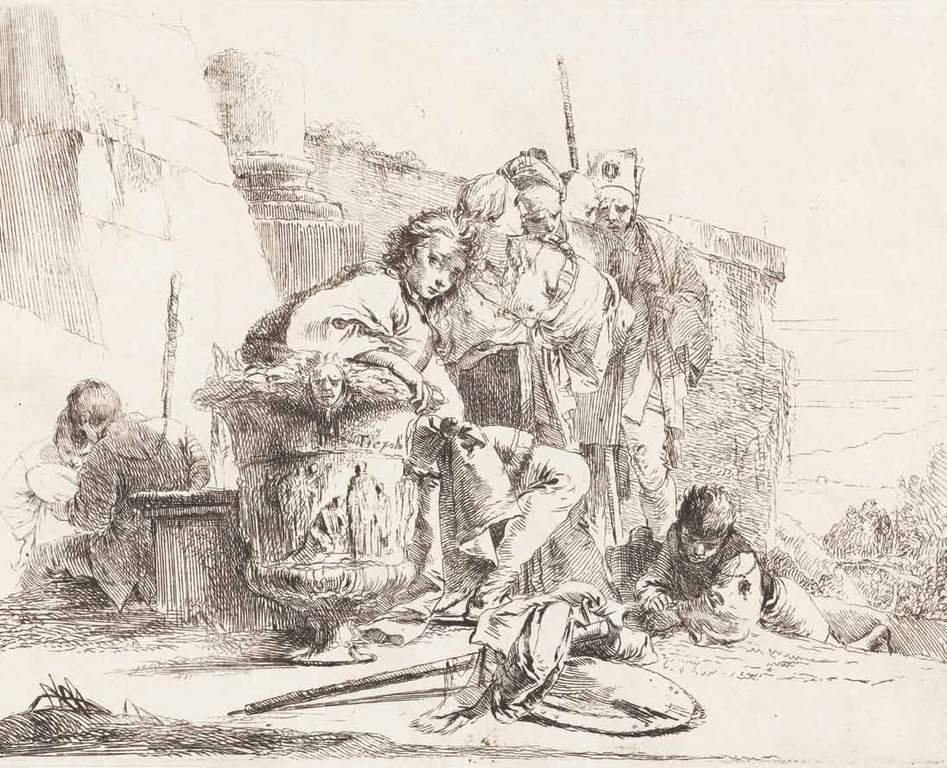
It was these etchings that gave Tordoir the inspiration for his latest project, The Pink Spy. The boundary between being watched and doing the watching oneself, and between art and audience, is unsteady and fitful, as in Boy sitting with a vase with several other figures (c. 1735-40). Looking at this requires involvement and makes one think. The work of both Tiepolo and Tordoir involves self-reflection and contemplation, rather than playing on the emotions.
Tordoir likes to call Tiepolo’s work, such as Wizard and woman with child sitting near a tree (c. 1750), ‘pre-ecological’, by which he implies that he considers the devastated settings depicted to be prophetic.
