Werk van jonge kunstenaars [Works by Young Artists]
Ensemble
“It has so often been said that painting is on its last legs, but this is utter nonsense.”– Narcisse Tordoir
Narcisse Tordoir has worked with a number of emerging professional artists at the Rijksakademie in Amsterdam. They represent several different positions, disciplines and cultures.
The very first work you see is by Ayman Ramadan. It is called The Situation is Fluid (2011) and consists of a bilingual sign (English and Arabic) of the sort one often sees in the streets of Cairo. The sentence comes from a statement issued by the White House on the situation in Egypt shortly after the revolution of 25 January 2011. The sentence was ridiculed by bloggers and demonstrators as proof of the United States’ questionable approach to the Middle East. Ramadan’s sign was spread through the streets by the inhabitants and in this way took the form of an indictment. This made art very topical and involved, thereby adopting an attitude and supporting people in their protest.
We also see this sense of engagement in the work of Hamid El Kanbouhi. He does his work for society and aspires to create art that also justifies its existence outside the art world. In Amsterdam (2011), he creates a new context within which the viewer can relate to the subject, in this instance the people in the street scene, by moving everyday things to a different setting – in this case a museum. He is constantly in search of unfamiliar directions that offer the public new perspectives on these subjects. On the basis of the notion that everything contains something divine, he conveys his amazement at human existence. El Kanbouhi sees the cow as a symbol of the mass that organic form can assume. It is milked and forms a metaphor for the wave of people who travel back and forth between the Netherlands (where he now lives) and Morocco (where he was born).
Stéphanie Saadé (Lebanon, 1983) goes a step further by involving the viewer in her study of the history of the landscape. Structure 3 (Suspended Horizon) (2012) focuses on the isolation of a single element of nature, the horizon, and creates an artificial relationship between it and a piece of furniture and the viewer himself. The viewer can decide how he wants to relate to the work: observing, active, passive, experiencing. The smooth movement of the setting sun can be seen as a metaphor for the Lebanese attitude to its violent past and the conflict-filled present.
More information can be found in the list below.

Items
View all-

Farafra
Willem de Rooij, Farafra, 2012. Installation.
-
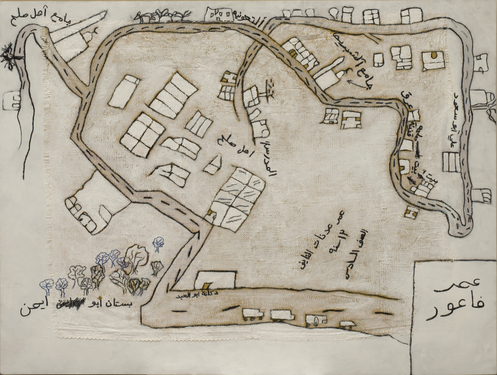
Shabriha 8
Marwan Rechmaoui, Shabriha 8, 2011. Painting, acrylic, china marker and oil pastel on synthetic burlap, 90 x 120 cm.
-
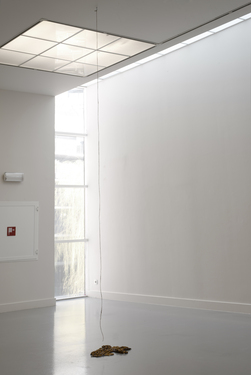
That That Had Had the Wha...
Aditya Mandayam, That That Had Had the What What, 2014. Sculpture, palm sugar and mixed nuts, variable dimensions.
-
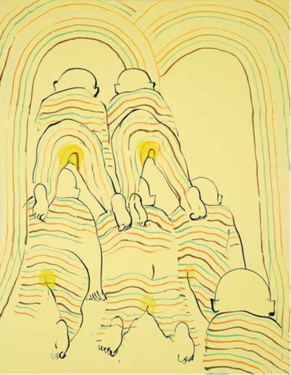
Piss Rainbow
Tala Madani, Piss Rainbow, 2008. Painting, oil on linen, 250 x 195 cm.
Actors
View all-
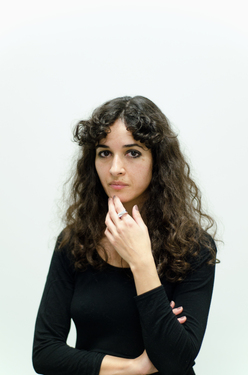
Stéphanie Saadé
The Beirut-based artist Stéphanie Saadé (b. 1983) pursues an artistic investigation into the history of the landscape. She makes this manife
-
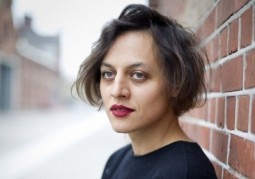
Tala Madani
The Iranian artist Tala Madani employs the art of painting to touch on religion, culture and sexual identity in a provocative and humoristic
-
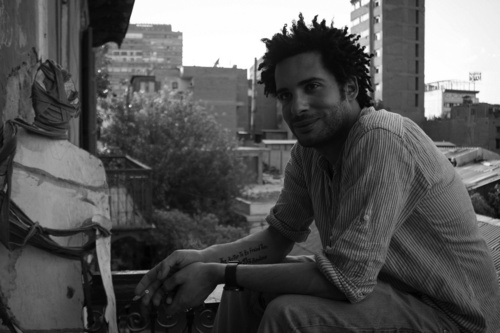
Ayman Ramadan
Ayman Ramadan moved to Cairo from the countryside when he was 16. He found a job as a security agent and would sleep in the minibuses and car
-
Niels Donckers
Niels Donckers' artistic work seems to limit itself to striking environmental conditions in crowdedly built Flanders: a region that illustrat