SUPERDEMOCATIE / SUPERDEMOKRATIE / SUPERDEMOCRACY
Ensemble
The voices of citizens are heard louder than ever in parliaments all over the world, while the diversity of who and what these institutions represent - people and things - is growing.
Social media now generate more regular interaction between citizens and their representatives, while many initiatives bring them together through all kinds of interest or action groups, whose objective is to broaden the decision-making base. Interaction and dialogue slowly come (back) to the centre of the decision-making process. Representative democracy is gradually transformed into a "deliberative democracy".
On top of that, what the parliament represents is also undergoing profound changes. It no longer merely represents an increasingly diverse "people", but also many "non-human" components of the world that also demand its attention. Animal rights, heritage conservation, technological development, energy use, and environmental protection are hot topics. It is increasingly evident that in order to survive, humans can no longer regard animals and "things" as just "possessions" or "at their service," but must instead see them as an integral part of the world, telling us something essential about this world and actual actors in the world. This is why, paraphrasing sociologist Bruno Latour, we are talking about the "Senate of Things".
By observing the increasingly turbulent and complex functioning of the political process, this exhibition is launching the concept of SUPERDEMOCRACY. Just as origin no longer suffices to explain the increasing diversity of our society, it is no longer suitable to reduce contemporary democracy to the voting booth and the hemicycle.
The SUPERDEMOCRACY exhibition highlights the concept of "con-certation". That it takes place in the Belgian Senate is no coincidence: as an assembly of federated entities, the Senate is the place of reflection and dialogue between communities on "cross-cutting issues". It is precisely on these subjects that three cultural institutions, BPS22 in Charleroi, BOZAR in Brussels and the M HKA in Antwerp, establish dialogue with the parliament.
The exhibition proposes a focus on fifteen topics in as many Senate halls. For each one, an artist of the Wallonia-Brussels Federation and one of the Flemish Community will be teamed with a third artist, from another Community.
Combinations of paintings, sculptures, photos, videos, installations, etc. of the BPS22 and M HKA collections propose a possible approach to the themes. Visitors are invited to discover the relations with the topics dealt with by the Senate, and between the works themselves, and to participate in the dialogue proposed.
This reflection continues throughout the month of October, during discussion and conference sessions organised by the three partners on these same issues.
Bart DE BAERE
Paul DUJARDIN
Pierre-Olivier ROLLIN
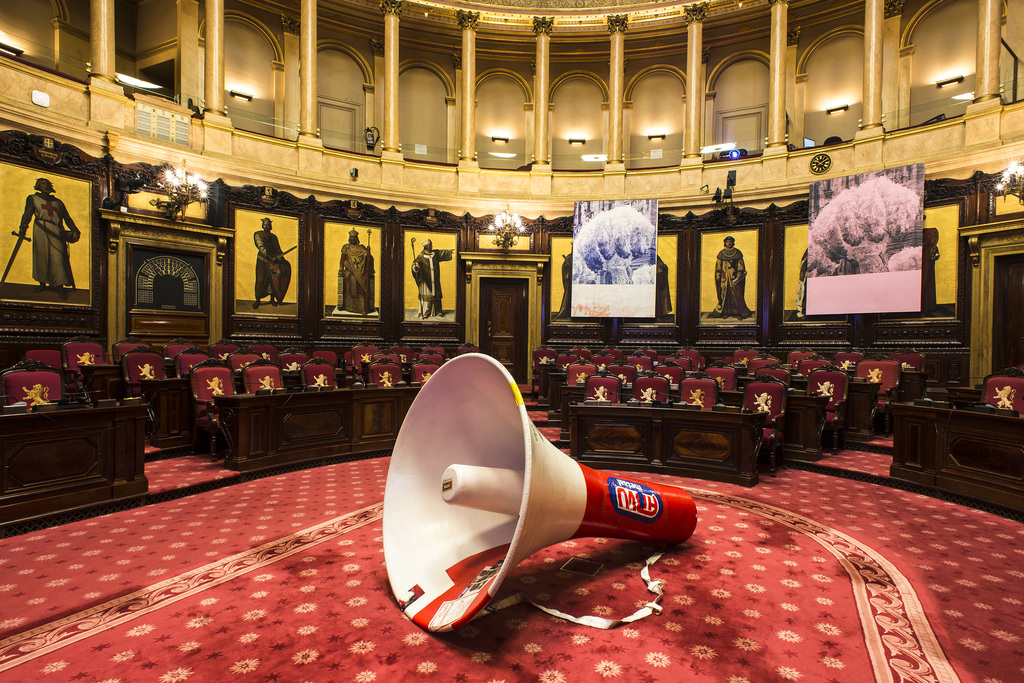
Items
View all-
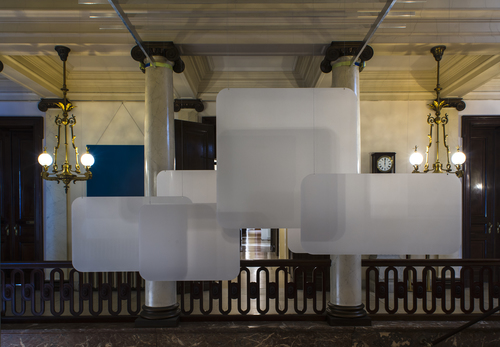
Screen
Carla Arocha, Screen, 2006. Installation, plexi, stainless steel, 216.4 x 350 x 150 cm.
-

L’Africeur de Bogolan
Narcisse Tordoir, Bréhima Kone, L’Africeur de Bogolan, 2004. Installation, bogolan, silkscreen, acrylic, variable dimensions.
-
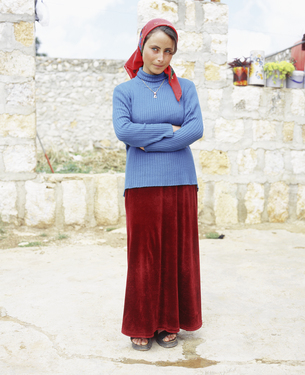
Série Syrie
Willi Filz, Série Syrie, 2001. Photography.
-

Drapeau
Emilio López-Menchero, Drapeau, 2015. Mixed Media.
Actors
View all-
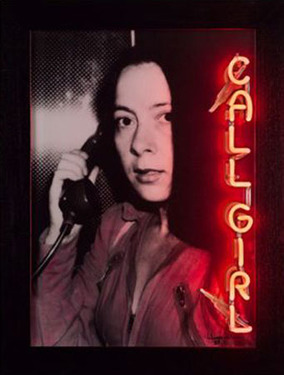
Liliane Vertessen
Liliane Vertessen (°1952) has, since the beginning of her career, developed an incredibly personal vision for her work, employing her own out
-

Suchan Kinoshita
Suchan Kinoshita (°1960) is born in Tokyo into a Japanese-German family. In the early eighties she studies music in Cologne. Throughout the e
-
Emilio López-Menchero
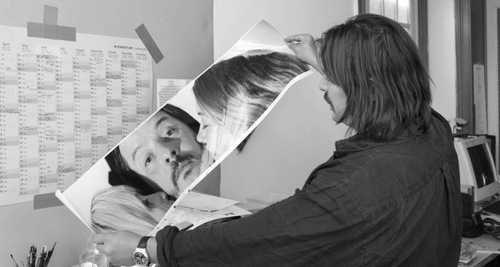
An architect by training, Emilio López-Menchero graduated from the La Cambre Institute of Architecture in (Brussels) in 1986. He devoted his
-

Jef Geys
Jef Geys (1934 - 2018) graduated from the Antwerp Art Academy and settled in Balen, in the Kempen region, where he worked as an art teacher a
Ensembles
View all-

ONDERZOEK / RECHERCHE / R...
Research, often limited to the empirical and scientific sphere, refers in fact to any gathering of data initiated by a question. This essenti
-
WELZIJN / BIEN ÊTRE / WEL...
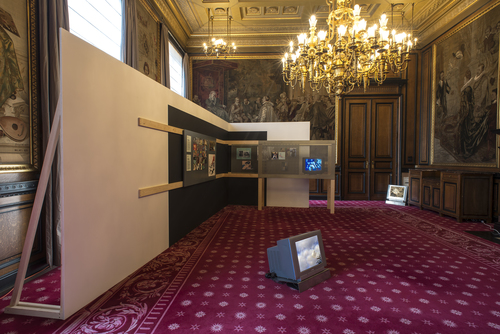
In a world with limited natural and social resources, the search for a balance between well-being and prosperity requires constant reflection
-

DIVERSITAS III
From women’s emancipation to homosexual and transgender rights. In our society, relational patterns between and among the sexes are becoming
-

MOBILITEIT / MOBILITE / M...
From a technocratic point of view, the term ‘mobility’ refers to road works, trucks, trains and airports. But mobility is also an existential