 Retour
Ensemble: SUPERDEMOCATIE / SUPERDEMOKRATIE / SUPERDEMOCRACY
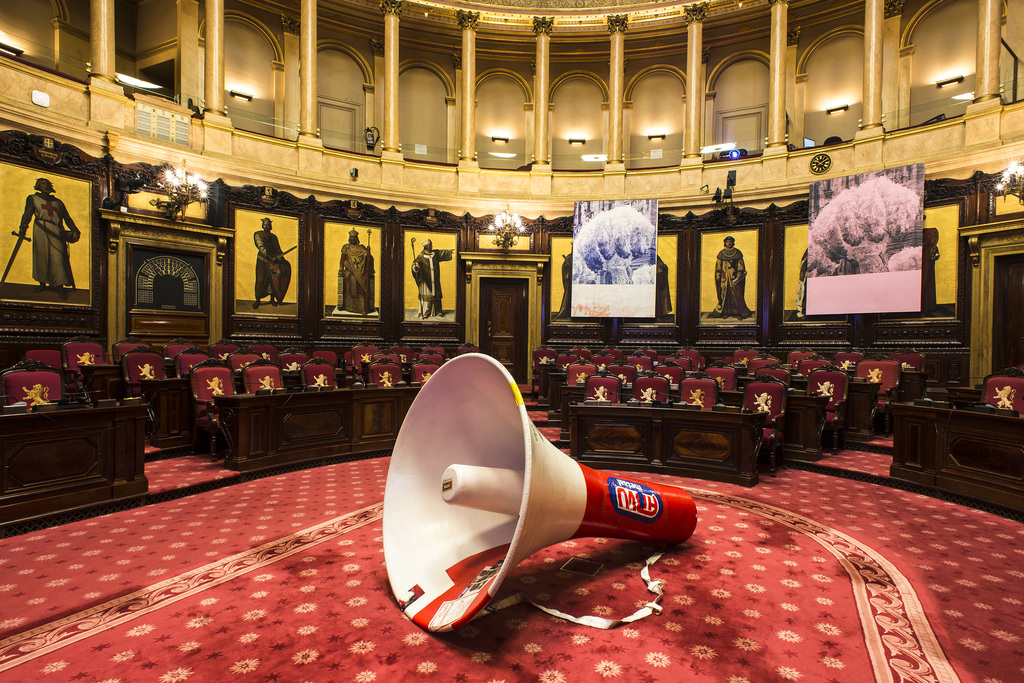
SUPERDEMOCRATIE
La voix des citoyens retentit de plus en plus fort dans les parlements du monde entier, alors que la diversité de ceux et de ce que représentent ces institutions – personnes et choses – ne cesse de croître.
Les médias sociaux instaurent désormais une interaction plus régulière entre le citoyen et ses représentants, tandis que de nombreuses initiatives les rassemblent par le biais de groupes d'intérêts ou d'actions en tout genre dont l’objectif est d’élargir la base décisionnelle. L’interaction et le dialogue (re)viennent doucement au centre du processus de décision. La démocratie représentative se transforme petit à petit en une « démocratie délibérative ».
Par ailleurs, ce que représente le parlement est également en profonde mutation. Il n’est plus seulement le représentant d’un « peuple » de plus en plus diversifié, mais aussi de nombreuses composantes « non-humaines » du monde qui réclament également son attention. Les droits des animaux, la conservation du patrimoine, les développements technologiques, l’exploitation des énergies, la protection de l’environnement sont d’une actualité brûlante. Il est de plus en plus évident que, pour survivre, l’homme ne peut plus considérer les animaux et les « choses » comme étant juste « sa possession » ou « à son service », mais doit les voir comme faisant partie intégrante du monde, disant quelque chose d’essentiel de ce monde et agissant dans le monde. Voilà pourquoi nous parlons ici, en paraphrasant le sociologue Bruno Latour, du « Sénat des Choses ».
C’est à partir du constat du fonctionnement de plus en plus mouvant et complexe du processus politique que cette exposition lance le concept de SUPERDEMOCRATIE. Tout comme l’origine ne suffit plus à expliquer la diversité croissante de notre société, il n’est plus question de réduire la démocratie contemporaine à l’isoloir et l’hémicycle.
L’exposition SUPERDEMOCRATIE met en exergue la « con-certation ». Elle ne le fait pas par hasard au Sénat de Belgique : en tant qu’assemblée des entités fédérées, le Sénat est le lieu de réflexion et de dialogue entre les communautés sur des « matières transversales ». C’est précisément sur ces matières que trois institutions culturelles, BPS22 à Charleroi, BOZAR de Bruxelles et le M HKA à Anvers, instaurent le dialogue avec le parlement.
L’exposition propose un focus sur quinze thèmes dans autant de salles du Sénat. A chaque fois, un artiste de la Fédération Wallonie-Bruxelles et un artiste de la Communauté flamande sont réunis avec un troisième artiste, issu d’une autre communauté. Les combinaisons de peintures, sculptures, photos, vidéos, installations, etc. des collections du BPS22 et du M HKA proposent une approche possible des thèmes. Les visiteurs sont invités à découvrir les relations avec les matières dont traite le Sénat et entre les œuvres elles-mêmes, et à participer ainsi au dialogue proposé.
Cette réflexion est poursuivie, tout au long du mois d’octobre, lors de salons de discussion et de conférences organisés par les trois partenaires sur ces mêmes thèmes.
Bart DE BAERE
Paul DUJARDIN
Pierre-Olivier ROLLIN
Themes & Categories
DIVERSITAS IV

SOLIDARITEIT / SOLIDARITE / SOLIDARITY / SOLIDARITÄT

INVENTIO

RES PUBLICA

RADICALISERING / RADICALISATION / RADIKALISIERUNG

WELZIJN / BIEN ÊTRE / WELL-BEING / WOHLERGEHEN

REFLECTIE / REFLEXION / REFLECTION

ONDERZOEK / RECHERCHE / RESEARCH / FORSCHUNG

DIVERSITAS II

DIVERSITAS III

MOBILITEIT / MOBILITE / MOBILITY / MOBILITÄT

TEKSTVERZORGING / TOILETTAGE DES TEXTES / TEXT QUALITY / TEXTPFLEGE
ECONOMIE / ECONOMY / WIRTSCHAFT
DIVERSITAS I

CONCORDIA
Oeuvres

There Are Snakes Everywhere…, 2017
Liliane Vertessen
Mixed Media, textile

Drapeau, 2015
Emilio López-Menchero
Mixed Media

Usine occupée. 46 portraits de travailleurs de Royal Boch, 2009
Véronique Vercheval
Photography

Ane(c)dote, 2009
Mira Sanders
Print, ink, paper

Impatiente, 1995
Tapta
Installation, steel and rubber on wheels, variable dimensions

Worthlessness, 1997
Edith Dekyndt
Video

Série Syrie, 2001
Willi Filz
Photography

Biblimlen, 2013
Sasha Pirogova
Video, hd video, sound, 00:10:00

Klok, 2017
Suchan Kinoshita
Object, glas, shampoo

La Méduse / l'Autruche, 2015
Marcel Berlanger
Print, 2 x (280 x 220 cm)

Global Empowerment, 2002
Sven 't Jolle
Sculpture, 141 x 143 x 210 cm

Sans titre (mains chaudes), 1990-1994
Michel François
Photography, 225 x 160 cm

Calais, 1995-2004
Marthe Wéry
Installation

Peinture Cérébrale, 1989
Jacques Charlier
Sculpture

Nach Diane Arbus, 2012
Miriam Cahn
Other, 180 x 110 cm

Immortality Is Just a State of Mind, 1987
Jean-François Octave
Other, 2 x (100 x 100 cm)

Atlas, 2006
Johan Muyle
Installation, 135 cm x 110cm x 90cm ; 220 cm x 116 cm x 105 cm ; 135 cm x 113 cm x 78 cm

Les Quatre Saisons de Moniteur belge, 1996
Denmark
Sculpture, 4 x (147 cm x 24 cm x 16 cm)

Les Animeaux de la ferme, 1974
Marcel Broodthaers
Print, ink, paper, 81.9 x 60.3 cm

United Colors, 2014
Thierry Verbeke
Other, textile, 225 x 150 cm

Corporate Armies, 2008
PSJM
Video

Mutus Liber 953, 2014
Kendell Geers
Sculpture

Djellabas Nike, Fila, Adidas, 1998
François Curlet
Installation

Réfractaires, 2016
Charlotte Beaudry
Installation, 345 x 302 cm

Tightrope, 2015
Taus Makhacheva
Video, 4k video, colour, sound, 01:16:00

Tracing Cheikh Anta Diop , 2014
Vanessa Van Obberghen
Photography, digital print on aluminium foil mounted on dibond, 150 x 100 cm

Le petit chevalet montrant le constat complété et le flacon, 2012
ORLAN
Object
![Nursing Activities, Direct (Verpulveren) [Nursing Activities, Direct (Pulverizing)]](https://s3.amazonaws.com/mhka_ensembles_production/assets/public/000/088/078/square_75/2022_Museum_In_Motion_AMVK_photo_M_HKA_clinckx_TEN_F_4.jpg?1665755613)
Nursing Activities, Direct (Verpulveren) [Nursing Activities, Direct (Pulverizing)], 1995-1998
Anne-Mie Van Kerckhoven / AMVK
Installation, videoband vhs, hout, metaal, 190,5 x 529 x 75 cm (geheel), 2 x 1 m (platen)

Birth of a Nation, 2003
Michael Van den Abeele
Multiple, textile, 140 x 210 cm

Ohne titel (Who's got the big picture), 2006
Johanna Kandl
Painting, tempera, canvas, 258 x 354 cm
![Zonder titel [Untitled]](https://s3.amazonaws.com/mhka_ensembles_production/assets/public/000/008/541/square_75/Tayou__Pascal__Vlag__Europees-Zuid_Africaans__2007_photo_clinckx1.JPG?1334222156)
Zonder titel [Untitled], 2007
Pascale Marthine Tayou
Object, textile, 92.5 x 146 cm

Maison Belge Supermarché de l'année, 2001
Angel Vergara
Painting, ink, canvas, crayon, acrylic, collage, 280 x 500 cm

Ladyboy - Curleyman I, 2007
Jan Van Imschoot
Painting, 190 x 170 x 3 cm

EU Vlag, 1999
Christophe Terlinden
Object, 92 x 150 cm

Inch'Allah, 2005
Ria Pacquée
Video, videotape digital betacam, dvd, 00:18:40

Down Under, 2009
Sheela Gowda
Sculpture, textile, 184 x 125 x 8 cm

1 hour 30 minutes sculpture, 2003
Vaast Colson
Print, lambda print, 86.5 x 88.6 x 5 cm

Anima Mundi (Bangkok), 1983
Marina Abramović & Ulay
Photography, colour photographs, 2 (116.5 x 117.5 cm); framed: 2 (130 x 190)cm

In 80 dagen rond de wereld - around the world in 80 days Weber - Madrid - Weber, 1993
Luc Deleu
Installation, mixed media, 193 x 102 cm
![Chaise découpée [Cut-Up Chair]](https://s3.amazonaws.com/mhka_ensembles_production/assets/public/000/036/988/square_75/2017_SUPERDEMOCRATIE_Senaat_photo_M_HKA_6_38.jpg?1506686700)
Chaise découpée [Cut-Up Chair], 1964-2008
Jacques Lizène
Sculpture, wood, canvas, 83 x 40 x 35 cm

L’Africeur de Bogolan, 2004
Narcisse Tordoir, Bréhima Kone
Installation, bogolan, silkscreen, acrylic, variable dimensions

Screen, 2005
Carla Arocha
Installation, plexi, stainless steel, 216.4 x 350 x 150 cm
![Water te Water [Water to Water]](https://s3.amazonaws.com/mhka_ensembles_production/assets/public/000/000/624/square_75/Mees,%20Guy,%20Water%20te%20water,%201970%20scan.jpg?1302191148)
Water te Water [Water to Water], 1970
Guy Mees
Video, dvd, 00:03:13

I Will Die, 2000
Yang Zhenzhong
Video, 00:11:36
![!Vrouwenvragen? [!Women's questions?]](https://s3.amazonaws.com/mhka_ensembles_production/assets/public/000/036/990/square_75/2017_SUPERDEMOCRATIE_Senaat_photo_M_HKA_6_40.jpg?1506687080)
!Vrouwenvragen? [!Women's questions?], 1965
Jef Geys
Installation, ink, paper, 600 x 140 cm

Change, 2005
Koka Ramishvili
Video, dvd, 00:04:20 min

Ode, 2001
Victor Alimpiev & Marian Zhunin
Video, dvd, 00:34:30 min
![Zonder titel (Broodkruis) [Untitled (Bread Cross)]](https://s3.amazonaws.com/mhka_ensembles_production/assets/public/000/000/030/square_75/Heyvaert,%20Ren%C3%A9,%20Untitled,%201988%20photo%20clinckx.jpg?1296656974)
Zonder titel (Broodkruis) [Untitled (Bread Cross)], 1981
René Heyvaert
Sculpture, bread, wood, 118 x 118 x 4 cm