SUPERDEMOCATIE / SUPERDEMOKRATIE / SUPERDEMOCRACY
Ensemble
The voices of citizens are heard louder than ever in parliaments all over the world, while the diversity of who and what these institutions represent - people and things - is growing.
Social media now generate more regular interaction between citizens and their representatives, while many initiatives bring them together through all kinds of interest or action groups, whose objective is to broaden the decision-making base. Interaction and dialogue slowly come (back) to the centre of the decision-making process. Representative democracy is gradually transformed into a "deliberative democracy".
On top of that, what the parliament represents is also undergoing profound changes. It no longer merely represents an increasingly diverse "people", but also many "non-human" components of the world that also demand its attention. Animal rights, heritage conservation, technological development, energy use, and environmental protection are hot topics. It is increasingly evident that in order to survive, humans can no longer regard animals and "things" as just "possessions" or "at their service," but must instead see them as an integral part of the world, telling us something essential about this world and actual actors in the world. This is why, paraphrasing sociologist Bruno Latour, we are talking about the "Senate of Things".
By observing the increasingly turbulent and complex functioning of the political process, this exhibition is launching the concept of SUPERDEMOCRACY. Just as origin no longer suffices to explain the increasing diversity of our society, it is no longer suitable to reduce contemporary democracy to the voting booth and the hemicycle.
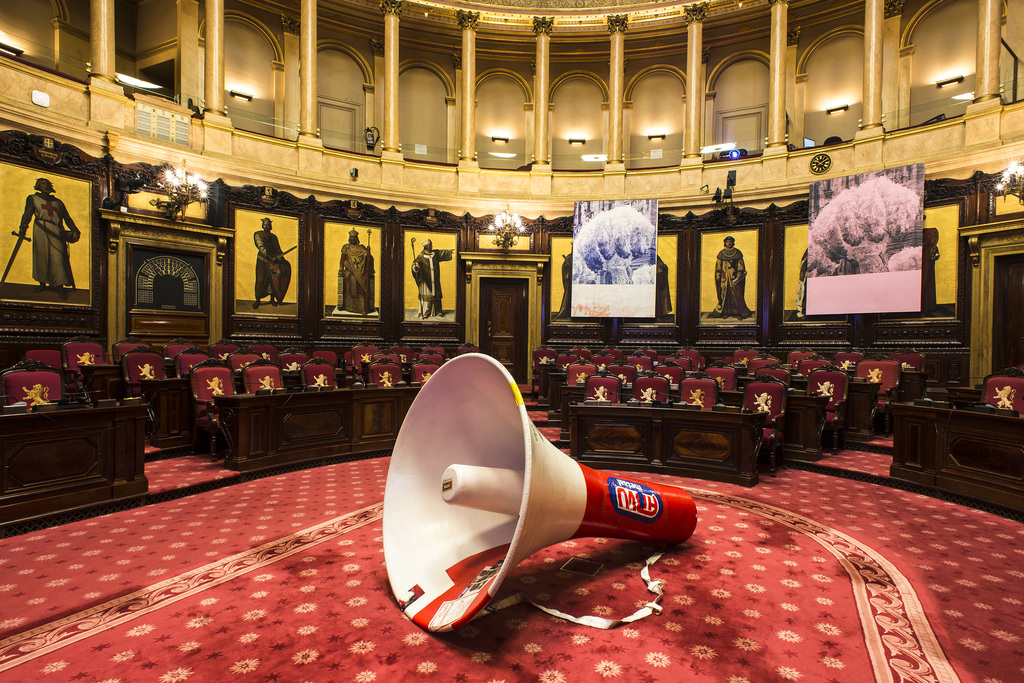
The SUPERDEMOCRACY exhibition highlights the concept of "con-certation". That it takes place in the Belgian Senate is no coincidence: as an assembly of federated entities, the Senate is the place of reflection and dialogue between communities on "cross-cutting issues". It is precisely on these subjects that three cultural institutions, BPS22 in Charleroi, BOZAR in Brussels and the M HKA in Antwerp, establish dialogue with the parliament.
The exhibition proposes a focus on fifteen topics in as many Senate halls. For each one, an artist of the Wallonia-Brussels Federation and one of the Flemish Community will be teamed with a third artist, from another Community.
Combinations of paintings, sculptures, photos, videos, installations, etc. of the BPS22 and M HKA collections propose a possible approach to the themes. Visitors are invited to discover the relations with the topics dealt with by the Senate, and between the works themselves, and to participate in the dialogue proposed.
This reflection continues throughout the month of October, during discussion and conference sessions organised by the three partners on these same issues.
Bart DE BAERE
Paul DUJARDIN
Pierre-Olivier ROLLIN
Items
View all-
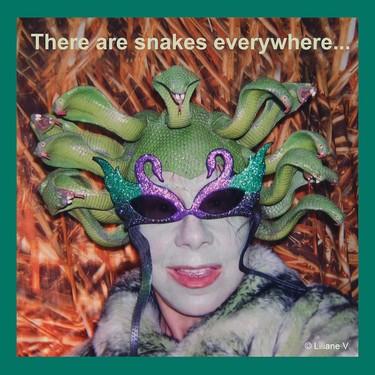
There Are Snakes Everywhe...
Liliane Vertessen, There Are Snakes Everywhere…, 2017. Mixed Media, textile.
-
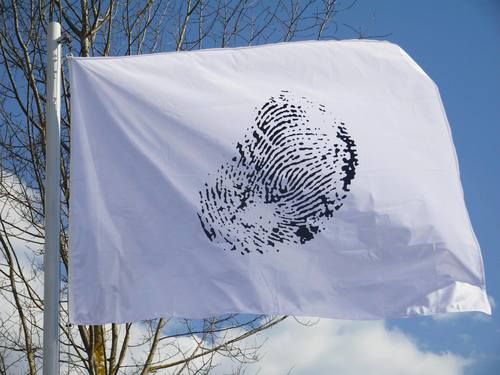
Drapeau
Emilio López-Menchero, Drapeau, 2015. Mixed Media.
-

Usine occupée. 46 portrai...
Véronique Vercheval, Usine occupée. 46 portraits de travailleurs de Royal Boch, 2009. Photography.
-
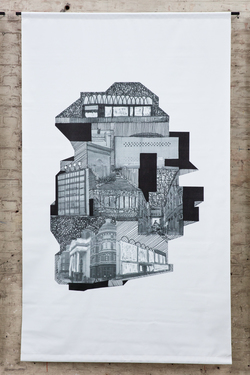
Ane(c)dote
Mira Sanders, Ane(c)dote, 2009. Print, ink, paper.
Actors
View all-

Johanna Kandl
Johanna Kandl (°1954) studied painting in Vienna and Belgrade. Kandl, who regularly collaborates with her partner Helmut Kandl, often researc
-
Narcisse Tordoir
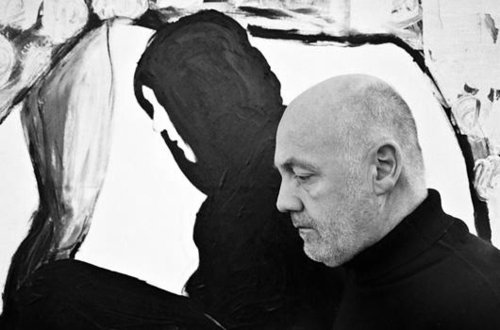
Narcisse Tordoir (°1954, Mechelen, Belgium) starts his career with experimental performances, alternative actions and spatial installations.
-

Taus Makhacheva
Between 2002 and 2013 Taus Makhacheva (°1983) follows different education cycles in arts, communication and economy, both in Russia and in En
-

Guy Mees
Guy Mees (1935-2003) emerges as a painter in Antwerp in the late fifties, when post-war avant-garde art from the US was just beginning to fin
Ensembles
View all-

MOBILITEIT / MOBILITE / M...
From a technocratic point of view, the term ‘mobility’ refers to road works, trucks, trains and airports. But mobility is also an existential
-
ECONOMIE / ECONOMY / WIRT...
Interpersonal exchanges, whatever their form, have constantly shaped civilisations; economic exchanges often being predominant. Yet individua
-

RES PUBLICA
The ‘public cause’, the political organisation of society, must be the central concern of all forms of power. Parliaments are its vital heart
-
REFLECTIE / REFLEXION / R...
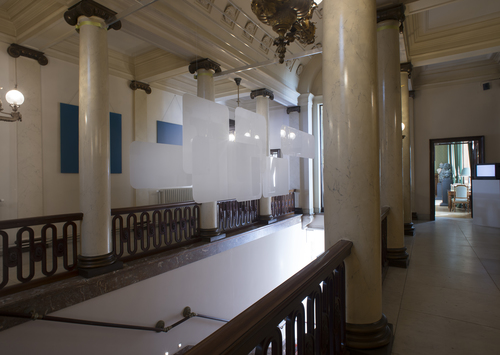
Just like mirroring, ‘reflection’ needs a counterpart. Reflection arises from the friction of encounters and can only take place when there i